Webflow’s MCP update brings traffic, tests and AI visibility into client reporting
Sima editorial · 11 November 2026 · Analysis · Release announced 15 October 2026
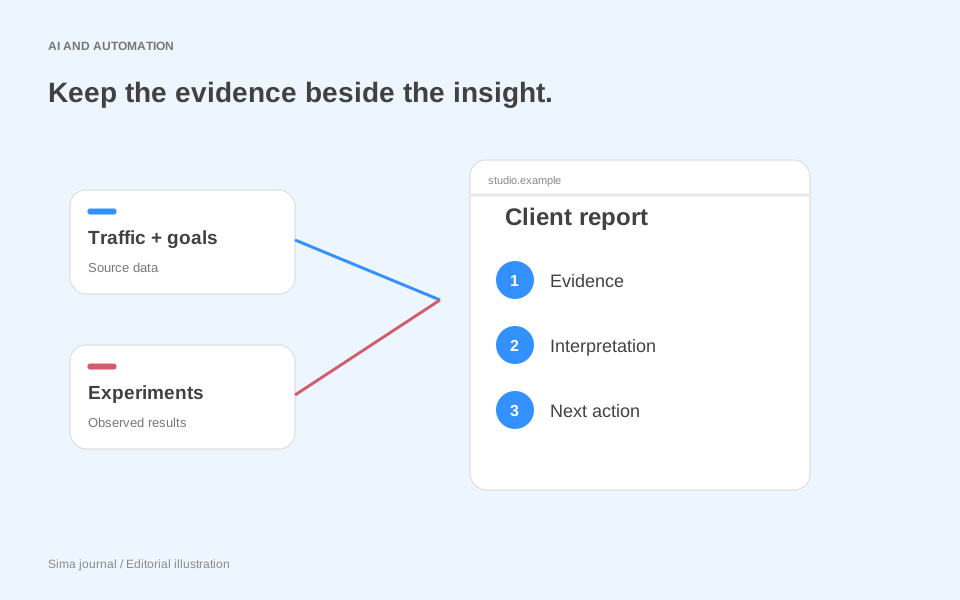
Webflow’s October update to its Model Context Protocol (MCP) server gives agencies a new way to prepare for the question that follows a website launch: what happened afterwards? An assistant can now retrieve page-level performance, experiment results and AI visibility information through the same connection it uses to understand the site. That puts several useful sources within reach of a client-reporting conversation. Webflow announced the release on 15 October 2026.
The opportunity is most interesting at page level. A client rarely needs another summary of total website traffic. They need to know whether the service page they paid to improve deserves more promotion, another experiment or further investigation.
What the agent can actually retrieve
The update brings three distinct kinds of evidence into the conversation:
- Analyze: page-level traffic and goal data, including filtered queries. This extends the site-level reporting agents could already access.
- Optimize: experiments and their results. The announcement describes reading which variation is winning; creating and editing experiments through agents remains in development.
- AEO Analytics: pages requested by LLM crawlers, with provider and crawler-category filters, plus tracked prompts and the answer engines’ responses.
Those capabilities are described in Webflow’s detailed launch article. They answer different questions. Visits describe audience activity; an experiment compares treatments; tracked answers show what an answer engine returned for particular prompts. Crawler requests alone do not establish that a page was cited in an answer.
For reporting, the useful change is the ability to examine these signals together without pretending they measure the same thing. An account manager can ask about a specific page, then follow up on a relevant test or tracked prompt while retaining the original business question.
A monthly report with a decision to make
Consider an illustrative agency retainer for a workplace-training company. Its client has a course landing page, an enquiry goal and a headline experiment. The next meeting must decide whether to spend the coming month’s budget on more traffic or on improving the page.
Begin with a bounded request: retrieve the landing page’s traffic and goal completions for two agreed periods, identify its current experiment and results, and show any relevant tracked AEO prompts. Ask the agent to retain the page, date ranges, metric names and source for every observation. Missing information belongs in the draft as a gap.
Suppose the returned data were to show more page visits with little movement in enquiry goal completions across comparable periods. That is the evidence, once checked against the source. “The new visitors may be less interested in this course” is an inference. “Rewrite the headline” is a decision, and neither of the preceding statements establishes that it is the right one.
The experiment gives the agency a more focused next question. Does its reported outcome support choosing a headline, or is the result still unsettled? The report should carry the experiment’s actual status and evidence, rather than promote whichever variation happens to be ahead into a recommendation.
Meanwhile, imagine a tracked answer fails to mention the company even though crawler requests include the course page. This could justify reviewing how clearly the page explains the course and its intended audience. It would not establish that poor AI visibility caused the enquiry pattern. These are separate lines of investigation with different owners and measures of success.
A useful recommendation would therefore be conditional: the analyst checks the traffic comparison and goal definition; the experiment owner reviews whether the test supports a decision; the content strategist examines the specific tracked answer before proposing changes. The client can then allocate work against an explicit uncertainty, rather than approve a redesign on the strength of a fluent paragraph.
Access determines the report’s real scope
MCP availability and analytics entitlement are separate. Webflow’s Help Centre overview says the server is available on all Site plans, but Analyze and AEO analytics require the Analyze add-on, while test data requires Optimize. Users with the Reviewer role cannot connect; other users retain their existing role permissions. A successful connection does not supply missing subscriptions or uncollected data. Analyze retrieval covers only authorised sites and follows their data-collection settings, according to the Analyze-specific guide.
There is also a practical agency constraint: developer documentation says each authorisation covers one workspace. Moving to another requires re-authentication; connector clients such as Claude and ChatGPT require removing and reinstalling the connector. Agencies serving clients in separate workspaces should allow for that boundary when designing a reporting routine.
Gemini joined the supported connectors in the October announcement, whose release notice describes support for Webflow Enterprise plans as still in development. The Gemini connection guide, updated 3 November, adds a more immediate constraint for UK agencies: the connector is currently US-only, in English, for adults using personal Google accounts with Keep Activity enabled. Work and school accounts are not supported yet.
Make the report hand off useful work
Keep the reporting brief focused on retrieval and a draft recommendation. The performance tools read data, but the wider MCP connection can also perform site-management actions within the user’s permissions. Specify the reporting task clearly and review proposed changes separately. Webflow documents that distinction.
Before the client meeting, check the few claims that would move budget: the comparison windows, goal meaning and experiment conclusion. Attach the relevant observations to each proposed action. Our client website review guide can help turn those findings into a discussion; the website review checklist provides a structure for investigating the page itself.
The agency’s contribution remains deciding what the evidence warrants. This update makes the evidence easier to bring into that decision.
Source and scope
Based on Webflow’s 15 October 2026 release announcement and linked primary documentation, including its 3 November Gemini guide, reviewed on 8 November 2026. The client scenario is illustrative; no client analytics were retrieved and no connector or product-account testing was performed.