Framer Convert puts the experiment brief inside the conversation
Sima editorial · 11 November 2026 · Analysis · Release announced 3 November 2026
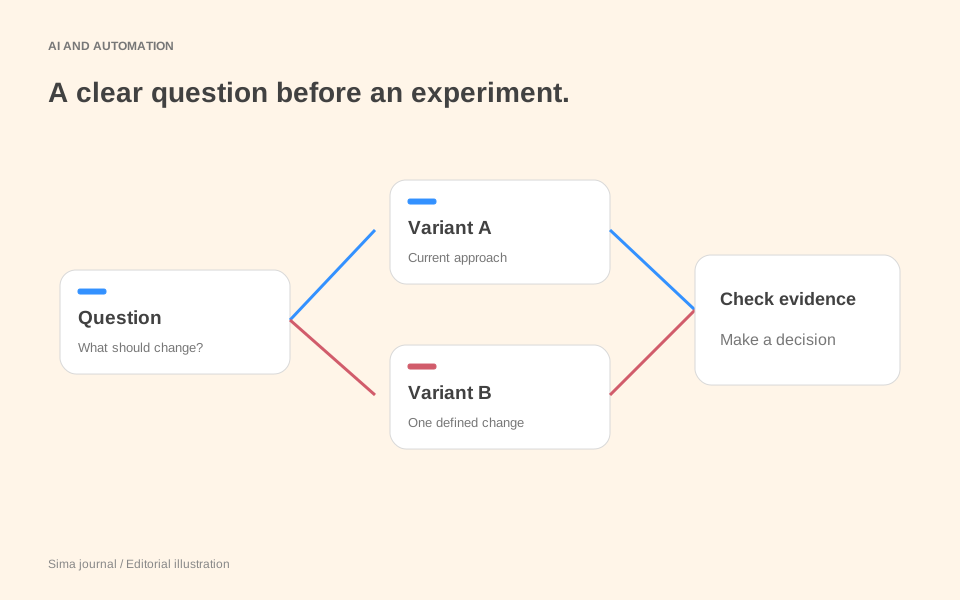
A training company wants more enquiries. Perhaps visitors cannot find its booking form. Perhaps they assume it sells individual tickets when it actually runs private workshops for teams. Those problems deserve different experiments.
Framer’s 3 November Convert update brings that investigation into the Agent conversation. The Agent can now create, edit and analyse funnels and A/B tests, and add or edit triggers. The release also introduces country-based triggers for showing overlays according to a visitor’s country or region. Agencies can move from a client’s question to a configured investigation with less manual setup.
Three tools, three different questions
A funnel describes a journey. Framer lets its steps contain page views, tracked link clicks or form submissions; the report shows conversion rates between steps. Device and country filters can help examine particular audiences. That makes a funnel a useful starting point for locating a problem, although a drop-off does not explain the visitor’s motive. Framer’s funnel guide documents the available steps and filters.
An A/B test introduces a comparison. Framer distributes traffic evenly between page variants and measures a defined conversion event. A trigger changes the experience when conditions and interactions are satisfied—for example, showing an overlay after a delay. Targeting a message and testing its effect are separate jobs. These distinctions matter when asking an agent to “improve conversions”: the request could mean observing a journey, running a comparison or changing what visitors see. A/B test documentation · Trigger documentation
The workshop page has a qualification problem
Consider a fictional training company whose sales team reports enquiries from people looking for single places. Its agency proposes changing the headline from “Make better decisions together” to “Private decision-making workshops for your team”. The price, imagery, form and call to action remain the same.
That is a more useful hypothesis than “clearer copy converts better”. The proposed headline makes the buying arrangement explicit. It might attract more relevant enquiries; it might also deter people who were never suitable customers. A lower submission rate would therefore need interpretation, rather than automatically counting as a commercial failure.
Start by mapping the current journey: workshop-page view, click through to the enquiry page, completed enquiry form. Use completion as the test’s final conversion step, while retaining the earlier click for diagnosis. Framer calculates the test’s conversion rate from the last configured step, and requires consistent tracking IDs on corresponding links or forms across variants. Setup guidance
An illustrative brief for the Agent could read:
Create a comparison of the current workshop headline and “Private decision-making workshops for your team”. Keep the rest of the page unchanged. Use completed enquiries as the conversion goal and include the enquiry-page click as an intermediate step. Explain the configuration for review.
Before starting and publishing the test, the agency should inspect both variants; after launch, verify that each journey records the intended submission. The mobile headline must remain readable: the experiment is about communicating the offer, not accidentally introducing a broken layout.
What the conversion report cannot settle
The business question extends beyond the form. A submission event does not tell the agency whether an enquiry concerns a team workshop, whether the buyer has a budget or whether a booking follows. The sales team should review enquiry suitability alongside the website results, keeping that assessment distinct from the measured A/B outcome unless reliable attribution connects them.
There is also a timing limit. Framer’s documentation says its anonymous A/B identifier resets daily, restricting conversion attribution to the same day. A Wednesday enquiry cannot be linked back to Monday’s exposure through that identifier, although Wednesday’s visit may generate its own test data. The results therefore describe a shorter journey than the eventual booking decision. Tracking and analysis guidance
Ask an agent’s analysis to identify the measured event, comparison period and unresolved question. A persuasive summary cannot supply missing observations. Our look at agent-assisted reporting explores the same boundary between retrieving figures and explaining their meaning.
A regional promotion is a separate intervention
Suppose the same company later runs a public workshop in Manchester. The new country condition could support a UK-targeted promotional overlay, while the ordinary private-workshop page remains available. Country targeting alone would not establish that a visitor lives near Manchester or wants a public ticket.
Framer’s trigger system includes scheduling and repeat conditions, and an optional tracking identifier records when a trigger fires. These provide useful controls for a time-limited promotion and a way to observe subsequent activity. They do not turn everyone who saw the banner into a randomly assigned experimental group. Trigger guide
The simplest plan is to finish the headline comparison before launching the promotion. Running both together is possible if the overlay is applied consistently across test variants, but then the headline result describes a site with that promotion in place. If exposure differs between variants, the agency cannot cleanly attribute the difference to the headline alone. For multilingual delivery, use a localisation strategy; country targeting alone does not choose a visitor’s preferred language.
Sell the learning, with its boundaries
Convert’s A/B tests and funnels are an add-on for Pro or Enterprise sites. Framer also acknowledges that low traffic or similar variants can leave a test inconclusive. Availability and results guidance
An agency can sell a defined engagement: clarify the uncertainty, configure a comparison, verify measurement and recommend a decision. The Agent helps with setup and analysis; the agency connects those numbers to the client’s problem—including recognising when fewer enquiries might be the right direction.
Source and scope
Based on Framer’s 3 November 2026 release and official documentation checked on 8 November, including the A/B guide updated on 5 November. Country targeting is described in the release; the older trigger guide does not detail its geographic granularity. The company, experiment and untested prompt are illustrative. No product-account test was performed or experimental results claimed.